Showing posts with label Paintings. Show all posts

Wednesday, January 18, 2017

"The Brothel"

Photo credit: Thomas Hawk via Foter.com / CC BY-NC
Modified 1/18/2017                                                                                By Nicole Gelfman
http://www.vincent-van-gogh-gallery.org/the-brothel.html
 "The Brothel" depicts a prostitution house scene, particularly before clients pursue what they came for. They are shown at a table sharing alcoholic beverages and speaking to one another. This heavily relates to the book considering the conflict that took place between Vincent and Rachel. Vincent asked to paint her in a brothel scene, however she was not comfortable with that because she did not want to be known as a prostitute. Vincent insisted that he would not make her known, hence the significance of this painting. The symbolism of Rachel's embarrassment with her profession is very evident. This painting was created in 1888 and is an oil on canvas. There are many loose vertical brushstrokes on the wall and floor, and overall loose color on the dresses shows Impressionism at its finest. The painting's mismatched colors also shows technique and methods of Impressionism. Brothels were very common for the time period, and socially shunned by the upper class. This kind of discrimination is seen commonly throughout the book as Rachel is usually stared at and looked down upon in public.


Tuesday, January 17, 2017

"Les Alyscamps"

Modified:1/12/2017                                                                                   By: Nicole Gelfman
http://entertainment.howstuffworks.com/arts/artwork/vincent-van-gogh-paintings-from-the-yellow-house10.htm

This is a real work as it depicts the Elysian Fields, an ancient cemetery in Arles that Van Gogh loved to paint. It is related to the story considering that Gauguin had arrived to live with Vincent in an artistic home, in which Vincent took Gauguin to this cemetery so they could paint together for the first time. This was important because Van Gogh was trying to make a good first impression, making it a strategic point in the novel. According to Entertainment, this painting was created in 1888, was an oil painting, and in the landscape genre. The style and technique portrays elements of Impressionism considering the brushstrokes are quick, light, and effortless making them thick and broad. The "looseness" of this work is common throughout the Impressionistic movements. Van Gogh and Gauguin visited the ancient Roman necropolis which was built by the Romans outside city walls. Eventually,  the grounds were overtaken by factories and the railroad. This lane was known throughout France as 'lovers lane,' making it significant between Rachel and Van Gogh. The couples portrayed in the painting were usually taking a romantic stroll in the evenings.

Les Alycamps
Photo credit: Benjamin Haas via Foter.com / CC BY-NC-SA

Thursday, January 12, 2017

"Starry Night over the Rhône"

Starry Night over the Rhône (1888)
Modified: 1/12/2017
by Ainon Hia Kazol
In chapter six, Rachel finds Vincent getting ready with all his art supplies; his work clothes, his canvas, an artist's box, and an easel strapped to his back. He tells Rachel, "It's time to try a night picture by the river." This picture ends up becoming the Starry Night Over The Rhône. According to an analysis made for this painting, it is a part of a series of starry night paintings in which Van Gogh celebrates the night sky by painting them. The three other paintings included in this series are the Starry Night, Cafe Terrance, and the Portrait of Eugene Boch. Vincent was satisfied with the outcome of this particular painting and his feelings about it are shown through many letters sent to his brother, Theo. This painting is an example of Impressionism art because Van Gogh actually painted this while looking at. Another reason why it's an Impressionist painting is because it shows how life at night was like, with all the lights shining on the water from the houses and the stars lighting up the sky.

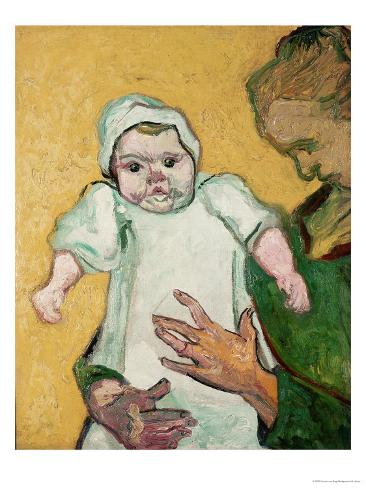
Madame Roulin with Baby

Madame Roulin with Baby (1888)
Oil on Canvas
Modified: 1/12/17                                                                                                      Jenna Palme
Vincent Van Gogh befriended the Roulin family during his stay in Arles.  He pained multiple portraits of each member of the family, but no one was painted as much as Madame Roulin and her baby, Marcelle.  In the novel, it's mentioned how caring Van Gogh is towards baby Marcelle and what a good father he would be if he settled down to have children.  The positioning of the baby makes it seem as if Marcelle herself is posing for Van Gogh.  The thick, visible brush strokes take give the painting an impressionist look.  The use of contrasting colors, like the yellow and green, is a signature of Van Gogh as that technique can be seen in many of his works.  The focus is on Marcelle and Madame Roulin is just a part of the background, essentially blending in with her surroundings.  Marcelle in white is the first thing the viewer sees when they spot this painting.  This work is mentioned in the novel as Rachel sees Van Gogh's paintings of the mother with her daughter and is reminded of her traumatic experience with a past pregnancy.  This work is currently housed at the Metropolitan Museum of Art along with some of his other pieces.  

Extra Link:

Wednesday, January 11, 2017

"The Yellow House"

Modified: 01/11/2017                                                                     By: Nicole Gelfman
https://www.vangoghmuseum.nl/en/collection/s0032V1962
https://en.wikipedia.org/wiki/French_architecture#Differences_Between_Homes_in_the_18th_Century_and_19th_Century

In the spring of 1888, Vincent Van Gogh rented four rooms in Arles, southern France, making this a real painting of his home. This work is included in the story considering the progressive history that occurred. This is where Rachel and Gauguin spent a portion of their lives, Gauguin actually living with Vincent, and Rachel spending nights and caring for him. Rachel, in particular is intrigued by this house, making it a subject of her curiosity. Van Gogh purchases this home because of the vast living space and spacious studio. His intentions where to turn it into an artists corner, where international painters could come live and advance their careers. This painting is an oil on canvas, which explains the prominence of loose brush-strokes and vivid color, as mentioned by the Van Gogh Museum.  This painting also displays common provincial architecture with tall second story windows, usually having distinctive designs. Additionally, it has a square and symmetrical shape, with windows on each entrance and corner. In short, there is a sense of height an dimension, as stated on the French architecture's encyclopedia. 


Photo credit: BlikStjinder via Foter.com / CC BY-NC