Showing posts with label sheramy bundrick. Show all posts

Thursday, January 12, 2017

"Starry Night over the Rhône"

Starry Night over the Rhône (1888)
Modified: 1/12/2017
by Ainon Hia Kazol
In chapter six, Rachel finds Vincent getting ready with all his art supplies; his work clothes, his canvas, an artist's box, and an easel strapped to his back. He tells Rachel, "It's time to try a night picture by the river." This picture ends up becoming the Starry Night Over The Rhône. According to an analysis made for this painting, it is a part of a series of starry night paintings in which Van Gogh celebrates the night sky by painting them. The three other paintings included in this series are the Starry Night, Cafe Terrance, and the Portrait of Eugene Boch. Vincent was satisfied with the outcome of this particular painting and his feelings about it are shown through many letters sent to his brother, Theo. This painting is an example of Impressionism art because Van Gogh actually painted this while looking at. Another reason why it's an Impressionist painting is because it shows how life at night was like, with all the lights shining on the water from the houses and the stars lighting up the sky.

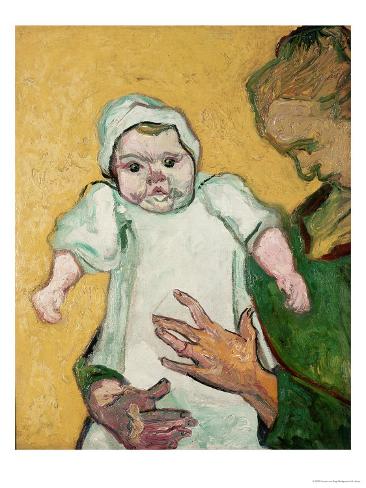
Madame Roulin with Baby

Madame Roulin with Baby (1888)
Oil on Canvas
Modified: 1/12/17                                                                                                      Jenna Palme
Vincent Van Gogh befriended the Roulin family during his stay in Arles.  He pained multiple portraits of each member of the family, but no one was painted as much as Madame Roulin and her baby, Marcelle.  In the novel, it's mentioned how caring Van Gogh is towards baby Marcelle and what a good father he would be if he settled down to have children.  The positioning of the baby makes it seem as if Marcelle herself is posing for Van Gogh.  The thick, visible brush strokes take give the painting an impressionist look.  The use of contrasting colors, like the yellow and green, is a signature of Van Gogh as that technique can be seen in many of his works.  The focus is on Marcelle and Madame Roulin is just a part of the background, essentially blending in with her surroundings.  Marcelle in white is the first thing the viewer sees when they spot this painting.  This work is mentioned in the novel as Rachel sees Van Gogh's paintings of the mother with her daughter and is reminded of her traumatic experience with a past pregnancy.  This work is currently housed at the Metropolitan Museum of Art along with some of his other pieces.  

Extra Link:

Wednesday, January 11, 2017

Portrait of Dr. Félix Rey

Portrait of Dr. Félix Rey (1889)
Oil on Canvas
Modified 1/11/17                                                                                                        Jenna Palme

Vincent Van Gogh's portrait of his doctor from Arles exists and is now housed in the Pushkin Museum in Moscow.  He painted this in January of 1889 as a gift for the doctor, but Dr. Rey wasn't a fan of the work as he thought it wasn't a realistic representation of himself and gave it to his mother.  Rey's mother thought the work was hideous and used it to repair her chicken coop according to the National Center of Biotechnology Information. Van Gogh's style wasn't popular at the time, so people weren't appreciative of his works as they are now.  In Sunflowers, Van Gogh paints Rey as a sort of thanks for being so kind and understanding to him during his time in the hospital after he cut off a piece of his ear.  In the book, Rey has an obvious attraction towards Rachel, so he wasn't painted in the most flattering manner.  The dark, clashing colors used don't give a complimentary look to the doctor.  His eyes seem almost pitch black from afar, then take a closer look at the image, and see the soft brown that was truly used to give the doctor a caring and kind demeanor.  The clear brushstrokes give off the impressionist style of lacking a polished look.  Vincent clearly admired the doctor as he tended to paint people he cared for and admired.   

Extra Links: